

Table of Contents
- Why a UV Sterilizer Belongs in Your Reef Tank Setup
- How UV Sterilizers Work and What They Actually Kill
- UV Sterilizer Sizing for Reef Tanks: Wattage and Flow Rate
- How to Install a UV Sterilizer in Your Aquarium
- UV Sterilizer Maintenance Tips for Long-Term Performance
- What Competitors Don't Tell You: UV Impact on Beneficial Bacteria and Coral Health
- UV vs. Ozone: Which Is Right for Your Reef Tank?
- Troubleshooting Common UV Sterilizer Problems
- Frequently Asked Questions
Last Updated: September 23, 2026
Why a UV Sterilizer Belongs in Your Reef Tank Setup
A UV sterilizer pushes aquarium water past a germicidal ultraviolet lamp to neutralize free-floating algae, bacteria, and parasites. For reef keepers battling green water or a stubborn bacterial bloom, it solves a problem filtration and water changes alone often cannot. At Premium Aquatics, we have sold and supported UV systems since the early days of the online saltwater hobby, and the pattern is consistent: tanks with chronic water clarity issues improve fastest when UV is added to sound filtration.
Here is the honest version most product pages skip: a UV sterilizer is not a cure for bad water quality. It manages what is suspended in the water column.
If your alkalinity is swinging or your bio-load is too high, UV will not fix that. If free-floating algae keeps returning despite water changes, UV is often the missing piece. Below, we break down sizing, flow rate, installation, and maintenance.
How UV Sterilizers Work and What They Actually Kill
Water enters the unit, passes a quartz sleeve that protects the lamp, and exits. The lamp emits ultraviolet radiation at a germicidal wavelength, and any micro-organisms exposed long enough are damaged beyond reproduction. UV does not remove debris, it stops organisms from multiplying, and the water column clears as the population crashes.
What UV handles well:
- Free-floating algae and algae spores, the main cause of green water
- Bacterial bloom, the milky haze in new or overfed tanks
- Waterborne pathogens, including many parasites in their free-swimming stage
What UV does not touch: algae attached to rock, substrate, or glass. It also cannot break the parasitic lifecycle if the parasite is on a fish. UV reduces free-swimming organisms, lowering reinfection pressure over time.
A common mistake is expecting overnight results. Most keepers see meaningful clarity improvement within several days to a couple of weeks, depending on tank volume and turnover rate.
UV Sterilizer Sizing for Reef Tanks: Wattage and Flow Rate
UV sterilizer sizing for reef tanks comes down to two numbers: wattage and flow rate. Get either wrong and sterilization efficiency drops, even though the unit runs fine. UV effectiveness is intensity multiplied by contact time, so a high-wattage lamp with water blasting past it can underperform a smaller lamp with throttled flow.
Calculating the Right Wattage for Your Tank Volume
Wattage must match tank volume and the level of pathogen reduction you want. Hobbyists pair lower wattage with smaller volumes and step up as tank size grows, a nano tank needs far less UV exposure than a large system with a heavy bio-load.
A practical starting framework most practitioners use:
| Tank Volume | Algae / Clarity Goal | Parasite-Control Goal |
|---|---|---|
| Under 40 gallons | 8-15 W | 15-25 W |
| 40-90 gallons | 15-25 W | 25-40 W |
| 90-180 gallons | 25-40 W | 40-65 W |
| 180+ gallons | 40-80 W | 65-120 W |
Those ranges assume a well-maintained quartz sleeve and a lamp within its rated life. They are starting points, not guarantees, a heavily stocked 120-gallon mixed reef fighting ich sits at the top of its band, while a lightly stocked 120-gallon softie tank chasing green water sits at the bottom.
Two questions decide your wattage: how big is the tank, and what are you treating? Clearing green water needs less; parasite control in a reef with fish needs more.
Flow Rate and Dwell Time: The Numbers That Matter
Dwell time is how long water stays exposed to UV. Push water through too fast and organisms pass the lamp without absorbing enough UV. Slow it down and sterilization efficiency climbs, but you risk under-turning the tank.
The industry convention for UV dose is measured in microwatt-seconds per square centimeter (µW·s/cm²), often written as mJ/cm².
| Goal | Flow Rate | Dwell Time | Wattage Priority |
|---|---|---|---|
| Water clarity, algae spores | Higher GPH | Shorter | Moderate |
| Bacterial bloom | Moderate GPH | Medium | Moderate |
| Parasite control | Lower GPH | Longer | Higher |
How to Install a UV Sterilizer in Your Aquarium
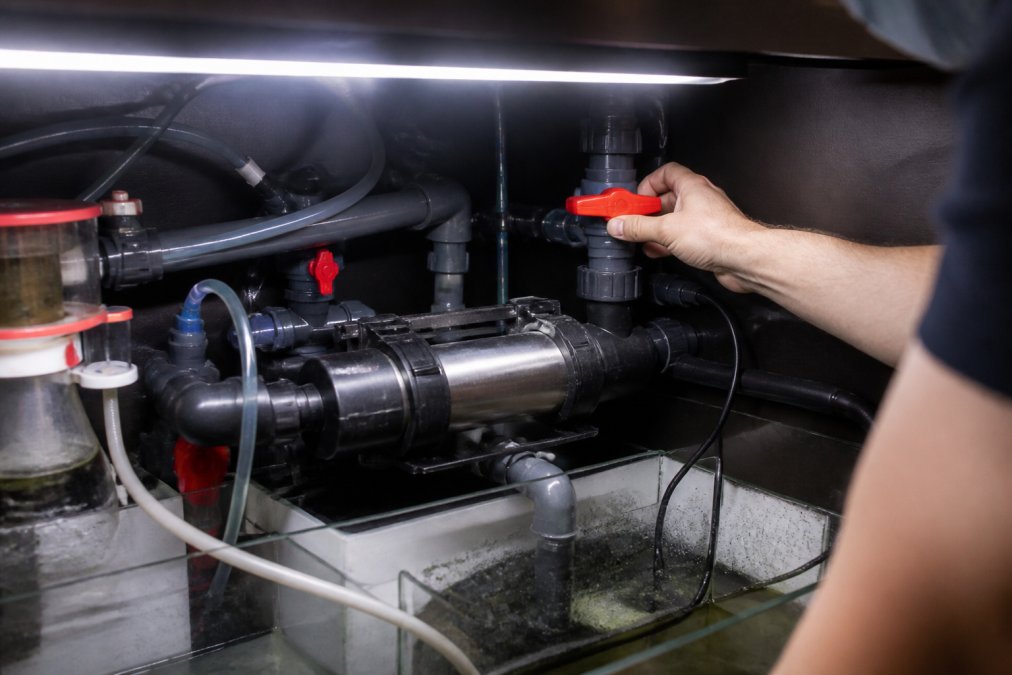
Installing a UV sterilizer in your aquarium is a plumbing job, not a chemistry experiment. The unit goes inline on the return path, typically fed from the sump. Water should pass through mechanical filtration first so debris does not shield organisms from UV exposure.
Inline vs. Hang-On Placement and Plumbing Basics
Inline installation is standard for reef tanks because it hides in the sump and works with existing return plumbing; hang-on units suit smaller setups or tanks without a sump. Either way, keep the unit below the water line of the return chamber to avoid running it dry.
- Use the correct barb or union fittings for your tubing size
- Add a ball valve so you can control flow rate precisely
- Support the unit so its weight does not stress the plumbing
- Prime the line before starting the pump
UV Sterilizer Maintenance Tips for Long-Term Performance
UV sterilizer maintenance tips mostly come down to one component: the quartz sleeve. A film of calcium or algae blocks ultraviolet radiation, and sterilization efficiency quietly falls even though the lamp still glows.
Bulb Life, Sleeve Cleaning, and the Real Replacement Cadence
Germicidal lamps are rated in hours, not months. UV-C output at the end of rated life can be a fraction of initial output, and that drop is invisible to the eye.
Sleeve cleaning cadence tracks water hardness.
Energy Use and Total Cost of Ownership
residential electricity rate data by state from the U.S. Energy Information Administration
What Competitors Don't Tell You: UV Impact on Beneficial Bacteria and Coral Health
Here is the question that worries most reef keepers, and it deserves a straight answer. UV does not wipe out the beneficial bacteria living in your rock and substrate. Those bacteria colonize surfaces. UV only affects what passes through the unit in the water column.
UV vs. Ozone: Which Is Right for Your Reef Tank?
Ozone and UV both target water quality, but they work differently and suit different keepers. Ozone is a strong oxidizer that can boost water clarity and protein skimmer performance, but it requires careful control and can affect ORP and livestock if misapplied.
Troubleshooting Common UV Sterilizer Problems
- No water clarity improvement: flow is too fast for adequate dwell time, or the sleeve is dirty
- Unit runs but green water returns: lamp has aged past its useful output
- Leaks at fittings: over-tightened connections or the wrong tubing size
- Overheating: running the unit dry or with flow blocked by debris
When you are ready to choose, Premium Aquatics carries UV sterilization systems built for both green water and algae control, with free shipping on orders over $49.00. Our team includes staff with backgrounds in marine and aquatic biology, and you can reach us by email or phone when you need help matching wattage and flow to your tank.
Frequently Asked Questions
Is a UV sterilizer worth it for a reef tank?
A UV sterilizer can be worth it if you struggle with water clarity, free-floating algae, or waterborne pathogens. It reduces bacterial bloom and parasite control by exposing micro-organisms to germicidal ultraviolet radiation. However, it won't replace proper filtration, water changes, or quarantine. For tanks with recurring green water or ich outbreaks, a UV sterilizer is a valuable tool. For healthy, stable tanks, it may be optional.
Does a UV sterilizer kill beneficial bacteria in a reef tank?
UV sterilizers primarily affect free-floating micro-organisms in the water column. Beneficial bacteria mostly colonize surfaces like live rock, sand, and filter media, so they are not significantly harmed. However, some planktonic bacteria and coral food may be reduced. Using a properly sized UV with correct flow rate minimizes impact on beneficial bacteria while still targeting pathogens and algae spores.
How long should you run a UV sterilizer in a reef tank?
Most reef keepers run UV sterilizers 24/7 for consistent water clarity and pathogen reduction. Some choose to run it only at night or during algae outbreaks. The key is maintaining steady flow and replacing the bulb every 6-12 months, as UV output diminishes over time. Running it continuously helps prevent bacterial bloom and keeps water quality parameters stable.
What size UV sterilizer do I need for my reef tank?
Sizing depends on tank volume and desired flow rate. Always check manufacturer recommendations and adjust based on bio-load and specific issues like algae spores or waterborne pathogens.
Chronic water clarity issues and recurring algae are frustrating, but they rarely require a full equipment overhaul. A properly sized UV sterilizer, matched to your tank volume and flow rate, solves the problem at its source. Premium Aquatics offers UV sterilization systems backed by expert support, free shipping on orders over $49.00, and a team that has guided reef keepers since 1996. Get started with Premium Aquatics and find the right UV setup for your tank.

